
Why You Keep Saying No to Online Yoga (And Why It's Time to Change That)

My sound healing sessions fill up within hours of being announced. My yoga wheel workshops have a waiting list. My retreats are usually booked out weeks in advance.
But my regular online yoga classes? Those take a different kind of effort to fill. A slower, more deliberate kind of coaxing. And for the longest time, I could not quite figure out why.
Then I started actually listening to what people said when they declined.
"I'll join next week."
"Once things calm down at work."
"When the kids are a little older."
"When I have a proper space."
The same reasons, cycling through, month after month. And what I eventually understood is that it was never really about timing or space or the kids. It was about a very specific picture people had in their heads of what an online yoga class would feel like. A picture that was inaccurate enough to stop them before they even began.
So let me paint you a different one.
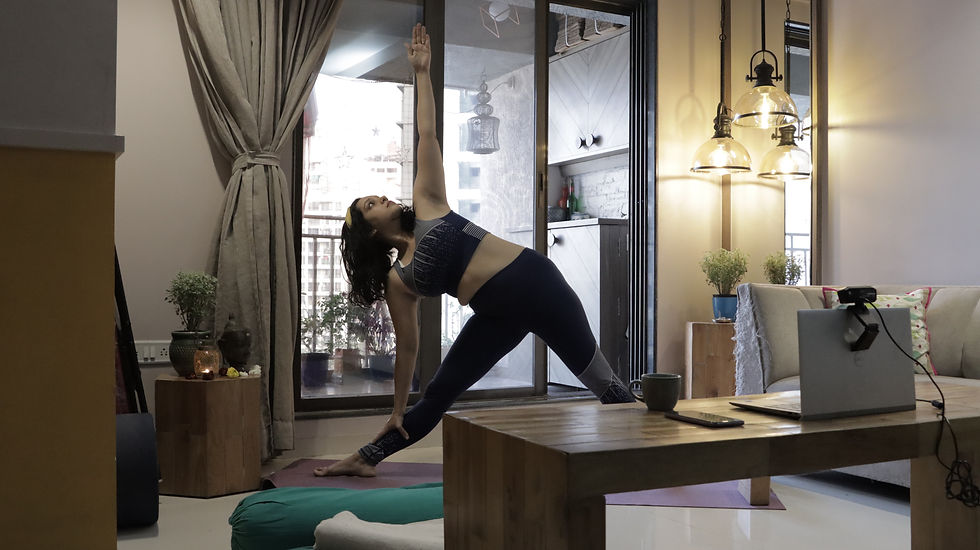
First, Let's Be Honest About How Tired Everyone Is
Most people today are not just busy. They are running on the bone-deep, eyes-burning kind of empty that comes from back-to-back shifts, school runs, project deadlines, aging parents, friendships that deserve more than a voice note at 11 pm, and somewhere in the middle of all of that, trying to remember to drink enough water.
By the time evening arrives, the body does not want to be challenged. It wants to be horizontal.
This is why special offerings feel easier to say yes to. A yoga wheel workshop has theatre to it. A retreat gives you permission to unplug from your entire life, which is arguably the most luxurious thing a human being can do. A sound healing session feels immersive before it even begins. You lie down, the bowls sing, and time dissolves.
But logging into a regular online class on a Wednesday evening after four meetings and no proper meal since breakfast? That asks something different. It asks you to choose it, deliberately, without the romance of an event or the escapism of a weekend away.
Most people are not sure it is worth it.
It is. I promise you it is. But first, let us deal with the stories keeping you from finding out.
"The Teacher Can't Really See Me."
This is the objection I hear most often, and it is the one most grounded in pure fantasy.
People imagine that behind a screen, they become invisible. That they could be doing anything — folding laundry, staring at the ceiling, performing some entirely improvised version of a pose — and no one would be any the wiser.
Let me be very clear: we can see you.
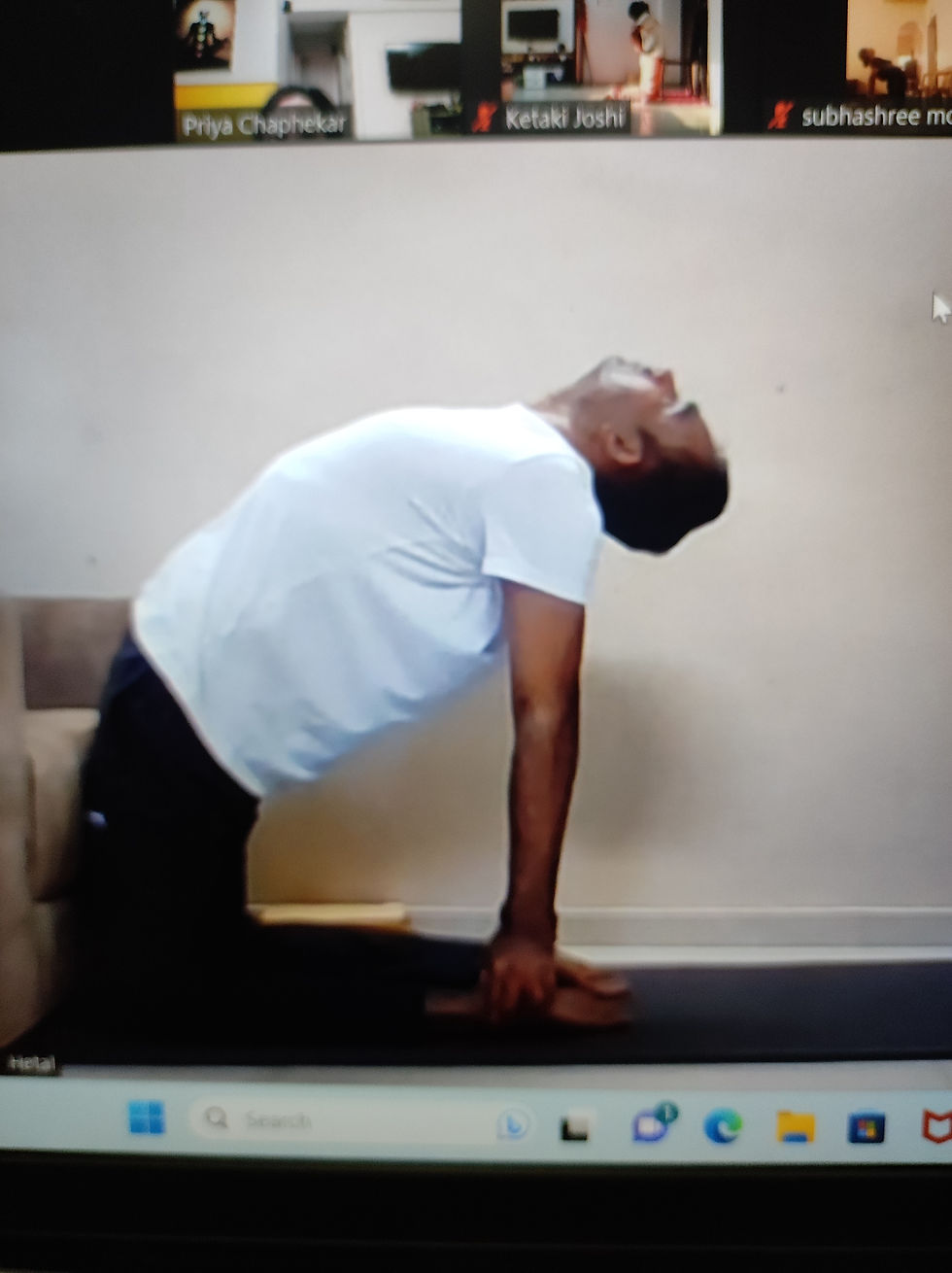
We can see the shoulder creeping up toward the ear as if it's trying to become an earring. We can see when one foot is bearing the entire weight of the pose while the other quietly goes on holiday. We notice when you have abandoned a posture mid-sequence and are hoping the camera angle will cover for you. We see all of it, not to embarrass you, but because watching bodies is the whole job.
And in many online classes, the quality of observation is actually sharper than in a studio. In a physical space, a teacher is moving through the room, adjusting someone at the back, keeping an eye on the clock. Online, everyone is right there in their little rectangle, and a teacher can read form and breath and effort in a way that is quite precise.
There is also the commute, or rather, the beautiful and complete absence of one. No traffic, no parking, no arriving flustered with your hair still half up. You close your laptop, walk four steps, and you are already there. That kind of frictionless access is not a small thing. It is very often the difference between showing up and not.

"I Won't Be Able to Keep Up."
Here is something that took me years to understand well enough to say out loud: the students who struggle most in an online class are rarely the least experienced or the least flexible. They are almost always the least present.
Phone face-up on the mat. Answering a message mid-plank. Opening the door for a delivery and returning still half in a lunge. Physically there, mentally everywhere else.
Your teacher needs exactly one thing from you: your attention. Not a perfect body, not years of experience, not a living room that looks like a lifestyle shoot. Just your attention, focused and genuinely offered.
When you give that, the class flows. The cues land. The body responds. If you have tried online yoga before and found it hard to follow, ask yourself honestly where your attention actually was. The class was probably doing its job.
"Online Yoga Doesn't Actually Give Results."
One of my students came to online classes during a period when she could not travel and could not get to a studio. She felt, she told me later, like she was just maintaining rather than progressing.
She was doing freestanding headstands within a year.
Online yoga absolutely gives results. I have watched students become measurably stronger, more mobile, more confident, and more rooted in their practice, through a screen, from their homes, on whatever mat they happened to own at the time.
But the results come through a particular mechanism worth naming: ownership. In a studio, it is easy to ride the energy of the room, to mirror the person beside you, to let the atmosphere carry you through. Online, you do not have that scaffolding. You have to bring your own focus. And in doing so, in learning to listen more carefully, to read your own body rather than borrow someone else's cues, you often build a relationship with your practice that is deeper and more durable than anything a beautiful studio could give you.
Consistency does the rest. When your class is twenty steps away instead of twenty minutes away, you show up more. And it is consistency, unglamorous, unremarkable, unphotographable consistency, that actually changes things.
"I Need the Energy of a Studio to Really Practice."
I love studios. I have practiced in spaces with soaring ceilings and the smell of sandalwood and light falling in exactly the right way. It is a real and particular pleasure.
But here is what I also know: yoga was never designed to be studio-dependent.
The practice was born in modest spaces. Refined in homes, on rooftops, in ashrams with bare walls and stone floors. The idea that you need beautiful surroundings, ambient lighting, and the right playlist to have a meaningful practice is, to put it kindly, a modern retail invention.
Your body does not have aesthetic preferences. It does not know whether it is in a studio in Bandra or a bedroom with the furniture pushed aside. It only knows whether you have arrived, whether you are breathing, whether you are paying attention. The mat is the space. Wherever you roll it out, that is the studio.

"Online Yoga Is Impersonal."
Here is what surprises people most when they commit to online classes over time: the intimacy of it. In a large studio class, a teacher knows you are there. In a regular online class, a teacher knows you.
We know which student's dog joins every Thursday session and wanders into frame during savasana without fail. We know who is perpetually searching for their yoga belt as class begins. We know who grumbles about backbends every single time and then completes them beautifully every single time. We know whose week has been hard without them saying so. We can see it in how they hold their breath, in the slight resistance in their shoulders.

The connection that forms in a regular online class is built through small, recurring moments rather than shared physical space. That is not lesser. In many cases, it is more specific and more attentive than a lot of in-person experiences I have had.
The Real Reason to Show Up
If I could say one thing about online yoga, it would be this: its greatest gift is not convenience. Its greatest gift is that it makes consistency possible in a way that nothing else quite does.
Retreats are transformative. Workshops expand your practice and your sense of what your body can do. But they happen occasionally. A few times a year if you are fortunate.
The real work happens in the ordinary classes.
The random Tuesday morning when you almost did not bother. The Thursday evening after a day that took more from you than you thought you had. The Sunday class you nearly cancelled because the sofa was nicer than the mat. The class where nothing felt particularly profound, but you showed up anyway, and the next time was a little easier because you had.
Nobody posts about those classes. There are no dramatic before-and-afters, no content worth sharing. But those are the classes that quietly, cumulatively, actually change you. That rewire the nervous system. That shift the breath. That slowly rebuild the relationship between you and your own body, one unremarkable session at a time.
That is what a practice looks like from the inside.
And online yoga, more than any other format I know, makes it possible to have one.
If you have been on the fence, consider this your nudge. The mat is right there. The class is twenty steps away. Come practice.
Join our online classes today.


Comments